Looking for relaxed, scenic cycling routes without steep hills, traffic stress, or complicated planning?
Our comprehensive brochure is designed to give you all the information you need, without the jargon and without the pressure.
A customer will often say the same thing to us in a slightly different way: “I know I need some help getting about, but I’m not sure what sort.” That is usually the real starting point in the mobility scooter or powerchair decision. It is not about picking the most impressive model on paper. It is about finding the option that makes everyday life easier, more comfortable and less tiring.
For some people, that means a scooter that folds neatly into the car boot for days out and holidays. For others, it means a powerchair that feels more natural to control in tighter spaces. Both can be excellent choices. The right one depends on where you use it, how you transfer on and off, how much support you need, and whether transport and storage matter just as much as comfort.
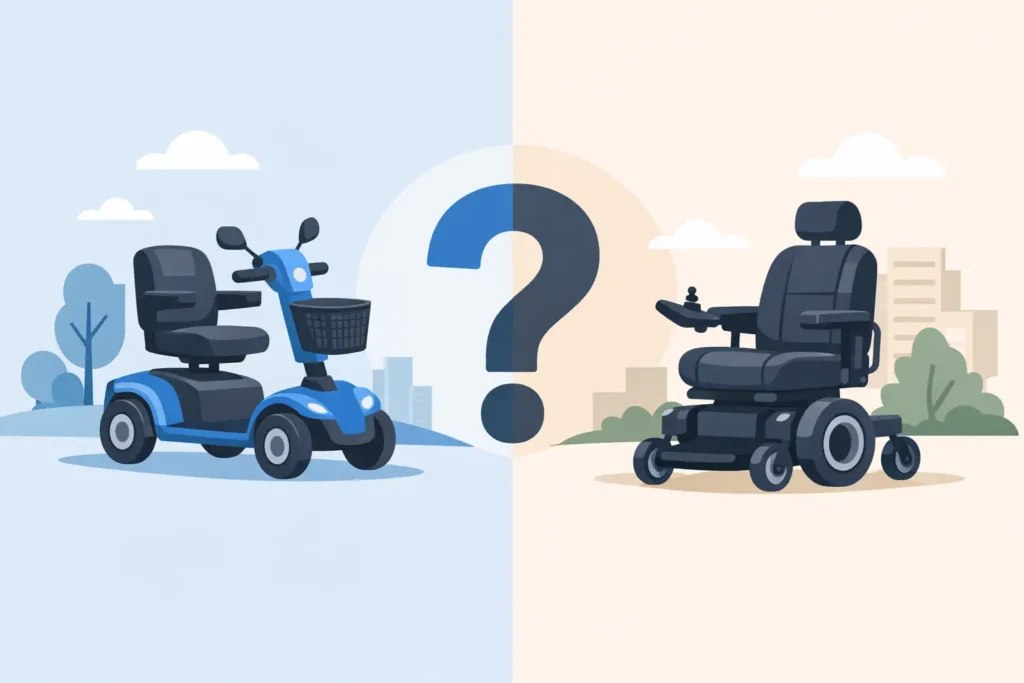
A mobility scooter is usually steered with handlebars or a tiller, and you sit facing forwards in a seat that feels quite familiar to many people. It is often the option people picture first when they think about mobility support. Scooters can be very practical for pavements, promenades, parks, shopping trips and general outdoor use.
A powerchair is controlled with a joystick, normally mounted on the armrest. It is designed more like a chair, with a tighter turning circle and a style of control that can feel more precise, especially indoors. Many people find a powerchair easier to manoeuvre around furniture, through doorways and in smaller shops or cafés.
That sounds simple enough, but in real life there is overlap. Some compact scooters are surprisingly portable, and some folding powerchairs are built with travel firmly in mind. That is why the question should not just be “Which is better?” but “Which suits the way you actually live?”
If most of your journeys are outdoors, a mobility scooter often makes immediate sense. The riding position is familiar, and many people feel confident with the tiller once they have had a short try. A scooter can feel steady and relaxed on longer outings, especially if your plan is to get from the car park to the seafront, from the campsite to the village, or around town without overdoing it.
If your use is more mixed, especially in tighter indoor spaces, a powerchair may have the edge. The joystick control allows for finer movement, and the turning circle is usually smaller. That can make a real difference at home, in garden centres, in lifts, or when navigating around tables in a café.
This is where honesty helps. Many people imagine they will mainly use their mobility aid outdoors, then find they want to take it everywhere. If you know from the start that it needs to work comfortably indoors as well as out, a powerchair deserves serious consideration.
When people compare a mobility scooter or powerchair, they often begin by looking at padding, backrests and armrests. Those things matter, of course, but comfort is also about posture, ease of control and how tiring the machine feels to use over time.
A scooter asks you to keep your hands on a tiller and to steer from the front. For many riders this feels natural and secure. For others, particularly if there is stiffness in the shoulders, wrists or hands, that steering position can become tiring.
A powerchair removes that front steering column and replaces it with joystick control. That can be a great relief if arm movement is limited or if steering a tiller feels awkward. It also leaves more open space in front of you, which some users find easier for getting settled and comfortable.
Then there is the question of getting on and off. A scooter seat may swivel, which can help with transfers. A powerchair may offer easier access in a different way, depending on the frame and armrest design. This is one of those areas where a brochure only tells part of the story. What feels easy for one person can feel completely wrong for another.
For customers who travel in a motorhome, keep equipment in a caravan, or simply do not want a bulky machine taking over the hallway, portability can be the deciding factor.
A folding mobility scooter can be a very appealing option if you want something straightforward to stow in a car boot or take away on holiday. Many people like the fact that it feels purpose-built for practical travel. Fold it, lift it, store it, and off you go. If your priority is getting out and about without fuss, that simplicity is hard to ignore.
Folding powerchairs can also be excellent for transport, especially if you want the compact storage benefits of a travel product with the control style of a chair. But weight, lifting method and folded shape all matter. One model may fit beautifully into a boot, while another may be awkward despite looking similar in photos.
This is why it helps to think beyond the words “folding” or “portable”. Ask yourself who will be lifting it, how far it needs to be carried, whether it must fit through a motorhome locker or sit behind the front seats, and how often you will be packing it away. Portability is not just about whether it folds. It is about whether it fits your routine without becoming hard work.
Some people sit on a scooter and feel at home straight away. The handlebars make sense, the controls are easy to understand, and the whole thing feels reassuringly familiar. Others try a scooter and feel that steering is less intuitive than they expected, especially in close quarters.
A powerchair can feel more precise from the start, particularly if you need small, careful movements. The joystick is often gentler for manoeuvring in busy or narrow places. That said, some users need a little time to gain confidence with joystick sensitivity, especially if they have never used one before.
There is no prize for choosing the type that sounds more advanced. The best choice is the one that helps you relax. If you are constantly second-guessing the controls, you are less likely to use it fully, and that rather defeats the point.
In broad terms, scooters often shine outdoors, while powerchairs often shine indoors. But broad terms only get you so far.
If your main aim is longer outdoor trips, a scooter may feel more stable and enjoyable for that sort of use. If your day regularly includes tighter indoor manoeuvres, a powerchair may save a lot of frustration. Where it becomes trickier is the customer who wants both – easy travel, easy storage, good pavement performance, and no trouble indoors.
That customer does exist, and there are products aimed squarely at that kind of flexible use. But there is usually a compromise somewhere. The more compact and travel-friendly a machine becomes, the more important it is to check whether it still feels comfortable and capable in your usual settings.
Before choosing a mobility scooter or powerchair, picture a normal week rather than a showroom floor. Are you mostly heading to the shops, visiting family, going away in the campervan, or moving around the house and garden? Do you have enough hand strength for tiller steering? Will somebody else help with lifting and storage, or must it be manageable on your own?
Also think about the little moments that shape day-to-day use. Where will it be charged? How easily can it be turned around near your front door? Will it fit where you actually need it to fit, not where you hope it might? These are not glamorous questions, but they are often the ones that prevent expensive mistakes.
At AS Folding Electric Bikes, this is exactly why practical advice matters so much. The right answer is rarely the one with the longest feature list. It is the one that makes getting out feel simple again.
If you want something that feels familiar, works well for outdoor trips and may be easier to picture as part of everyday errands and holidays, a mobility scooter could be the better fit. If you need tighter manoeuvrability, gentler control and a design that works especially well in more confined spaces, a powerchair may suit you better.
And if you are still undecided, that is perfectly normal. This choice is not about getting the “best” product in general. It is about finding the one that fits your body, your home, your journeys and your confidence.
A good mobility aid should not make life feel more complicated. It should quietly remove obstacles, give you back a bit of freedom, and make those ordinary outings feel possible again.