

Looking for relaxed, scenic cycling routes without steep hills, traffic stress, or complicated planning?
Our comprehensive brochure is designed to give you all the information you need, without the jargon and without the pressure.
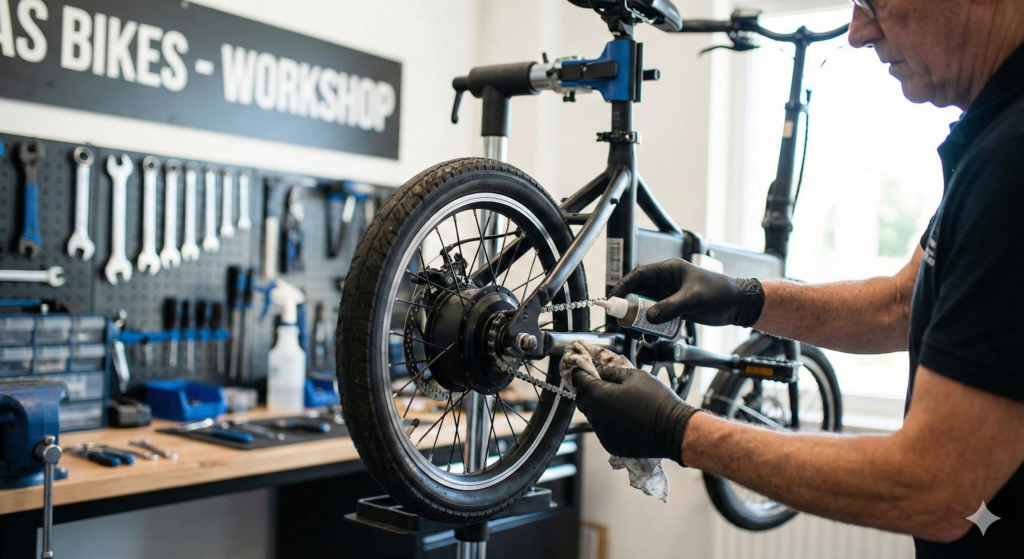
In a modern world obsessed with “newness,” where phones are replaced every two years and washing machines seem designed to fail the day after their warranty expires, there is something rebellious about durability. At AS Bikes, we come from a different school of thought. We believe that if you buy a quality machine, it should last.
We regularly see customers at shows who are still riding the same Electrobike they bought from us in 2010. The paint might be a little faded, and the tyres might have been replaced a few times, but the soul of the bike – the frame, the motor, and the mechanism – is still going strong.
However, longevity doesn’t happen by accident. An electric bike is a marriage of two distinct technologies: the mechanical (chains, gears, bearings) and the electrical (battery, motor, controller). When you combine this with the unique lifestyle of our customers – often storing bikes in motorhomes, caravans, or boats for months at a time – maintenance becomes critical.
This guide goes beyond the basic owner’s manual. It is a deep dive into how to protect your investment against the specific enemies of the leisure cyclist: damp, salt, vibration, and neglect.
The usage pattern of an AS Bikes customer is very different from that of a daily commuter. A commuter rides 10 miles every day, rain or shine. Their bike wears out through constant friction.
Our customers, conversely, tend to use their bikes intensively for short bursts (summer holidays, weekend trips) and then store them for long periods (winter lay-ups). This “feast or famine” usage creates specific problems.
Understanding this cycle is the key to maintenance. You aren’t just maintaining a bike; you are managing its storage.
The lithium-ion battery is the most expensive component on your e-bike. It is also the most temperamental. In the industry, we often see batteries fail not because they were used too much, but because they were ignored.
The Chemistry of Neglect Imagine a battery like a muscle. If you don’t use it, it atrophies. If you leave a battery at 0% charge for three months over winter, the voltage in the cells can drop below a critical safety threshold. Once this happens, the Battery Management System (BMS) – the brain inside the battery – will refuse to let it charge ever again to prevent a fire risk. This is a permanent, expensive failure.
The “Goldilocks” Zone Conversely, storing a battery at 100% for months is also stressful for the chemistry. The ideal storage state is around 60-80% charge.
The “Cold Start” Warning Never charge a lithium battery that is freezing cold. If you have left the battery in the motorhome overnight in January and it’s -2°C, do not plug it in immediately. Bring it inside and let it warm up to room temperature for an hour first. Charging a frozen battery can cause internal plating that permanently ruins its capacity.
This is a point rarely discussed in general cycling magazines. If you transport your bikes in a motorhome garage or on a rear rack, they are subjected to hours of low-frequency vibration from the road.
A 500-mile drive to the South of France shakes every nut, bolt, and screw on your bike. We have seen customers arrive at a campsite only to find a mudguard loose or a pedal rattling.
The Pre-Flight Check Treat your bike like a pilot treats a plane. Before you set off on a big trip, and again when you arrive, do a “bolt check.”
There is nothing better than a ride along a promenade in Cornwall or a coastal path in the Highlands. However, sea air is laden with salt, and salt is the enemy of electrical contacts. It corrodes copper and aluminum silently.
If you have been near the sea, do not just put the bike away.
E-bikes are heavier than standard bikes. When you add a rider and perhaps some shopping in the basket, the load on the tyres is significant.
Running soft tyres is the biggest “false economy” in cycling.
Check your pressures before every trip. For 20-inch wheels, you often need higher pressure than you think (often 40-50 PSI, but check the sidewall).
Electric bikes put more strain on chains than manual bikes. When you are in a high gear and you use the throttle or high-assist mode to storm up a hill, the chain is transmitting both your leg power and the motor’s torque.
This causes “chain stretch.” A stretched chain will start to eat the teeth on your gears.
We are big fans of DIY maintenance. Fixing a puncture or tightening a saddle is a satisfying skill. However, modern e-bikes have complex electronics.
If you experience electrical faults – like the motor cutting out intermittently, or error codes on the display – it is usually best to call us. We have the diagnostic tools to check the controller and sensors. Poking around with a screwdriver inside the battery casing or motor hub is dangerous and will void your warranty.
Furthermore, we recommend a professional service once a year, or every 2000 miles. At AS Bikes in Coventry, we strip the bike down, check the spoke tension (crucial on hub-motor wheels), update any software, and test the battery capacity. It’s the MOT for your bike.
In the leisure industry, your vehicle and your equipment are your tickets to freedom. A broken down motorhome or a flat e-bike battery can ruin a holiday.
By adopting a mindset of “preventative maintenance,” you ensure that your AS Bike is always ready when you are. Whether you are pulling it out of the bilge of a canal boat or the garage of a luxury liner, a well-maintained machine is a joy to ride. It’s reliable, it’s safe, and it’s ready for the next adventure.