

Looking for relaxed, scenic cycling routes without steep hills, traffic stress, or complicated planning?

Our comprehensive brochure is designed to give you all the information you need, without the jargon and without the pressure.
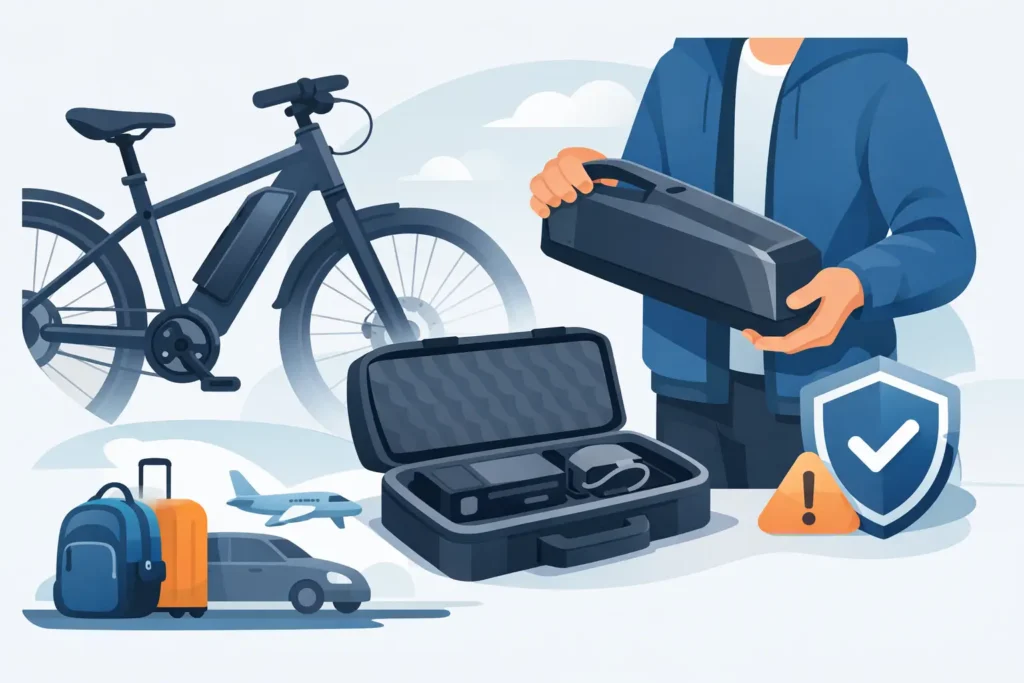
You usually notice the weight of an e-bike battery at the exact wrong moment – halfway across a car park, while lifting it into a motorhome locker, or when you’re trying not to knock it against a door frame. If you’re wondering how to carry ebike battery packs safely and comfortably, the good news is that a few simple habits make a big difference.
For many riders, especially those using folding electric bikes for holidays, day trips or easier everyday travel, the battery often comes off the bike more often than the bike itself gets folded. You might remove it to lighten the bike before lifting, to charge it indoors, or to store it more securely. That means carrying it properly is not just about protecting the battery – it is also about protecting your back, your hands and your confidence in using the bike day to day.
An e-bike battery is compact, but it is rarely light. Depending on the model, it may feel heavier than expected because the weight is dense and concentrated. Unlike a shopping bag, it does not always have an easy shape to hold, and if the casing is smooth, it can be awkward to grip for more than a short distance.
There is also the issue of cost. Batteries are one of the more valuable parts of an electric bike. A knock, a drop or water getting into the wrong place may not always cause visible damage straight away, but it can shorten the life of the battery or create problems later. So the aim is simple – carry it in a way that is safe, steady and does not ask too much of you physically.
The safest way to carry most e-bike batteries is close to your body with both hands, rather than dangling it at arm’s length. Keeping it close reduces strain on your shoulder and lower back, and it gives you far more control if you need to step up a kerb or move through a narrow doorway.
Before lifting, make sure the battery is properly switched off if your model has a power switch. If there is a protective cover for the terminals or key slot, fit that too. Then lift using a firm grip, ideally around the built-in handle if the battery has one. If it does not, support the base with one hand and steady the side with the other.
If you only need to move it a few steps, that may be enough. For longer distances, it depends on your strength and the battery shape. Some riders are fine carrying it by hand from house to car. Others find it uncomfortable after a minute or two. If that sounds familiar, there is no prize for struggling through it. A padded battery bag or small carry case can make a real difference.
If you regularly remove your battery for travel or charging, a dedicated padded bag is worth considering. It gives you a handle, sometimes a shoulder strap, and helps protect the casing from knocks. It also stops the battery sliding about in the boot or inside a motorhome cupboard.
That said, not every bag suits every person. A shoulder strap can sound convenient, but a heavy battery on one shoulder may feel less stable than carrying it by hand. For some people, especially those managing reduced strength or balance, a short-handled bag held close to the body is the easier option.
One of the simplest tips is to prepare where you are going before you pick the battery up. Open the car door first. Clear a space on the table before bringing the battery in to charge. Make sure the path from bike to charger is dry and free of clutter.
Most awkward moments happen when someone is trying to do two things at once – carrying the battery and shifting a bag, opening a gate or moving shoes out of the hallway. A clear route turns a fiddly job into a straightforward one.
A lot of folding e-bike owners remove the battery before loading the bike into a car boot or storage compartment. It makes the bike lighter and easier to manage, which is often the whole point. But once the battery is off, it still needs to be transported properly.
The best approach is to place it somewhere stable, dry and cushioned, where it cannot roll or slide around. A padded bag helps here, but even with a bag, avoid loose placement on a hard floor where it can tip over during braking or cornering. If you are travelling in a campervan or motorhome, choose a spot away from direct heat and away from anything heavy that could shift onto it.
It is also sensible not to leave the battery in a very hot vehicle for long periods. Warm conditions are one thing, but intense heat inside a parked vehicle in summer is not ideal for battery health. If you can take it indoors with you, that is usually the better choice.
If you are taking your battery with you on a ferry, train or while staying away, the key point is secure handling rather than improvised carrying. A battery tucked inside a general shopping bag can bump against other items, and that is not ideal. A purpose-made case or a sturdy padded bag is safer and easier to manage.
It is also worth checking travel rules in advance. Different operators can have different policies on e-bikes and lithium batteries. That is less about carrying comfort and more about avoiding surprises when you arrive.
For holidays, many people find it easiest to create a simple routine. Keep the charger, battery, keys and any covers together in one place. That way you are not hunting around every time you want to go for a ride.
The biggest mistake is carrying the battery one-handed by a poor grip point. That is when drops happen. If the battery has a handle, use it. If not, take a moment to get both hands in the right place before moving.
Another common mistake is placing the battery on the ground in a risky spot while unlocking a door or folding the bike. It only takes one accidental nudge for it to topple. Put it on a flat, stable surface when possible, even if that means an extra step.
People also sometimes focus so much on battery safety that they forget personal safety. If the battery feels too heavy, the answer is not to push through. Remove obstacles, shorten the carrying distance, use a bag, or ask for help. Practical transport should make life easier, not harder.
Carrying and storing are closely linked. Once you have moved the battery indoors, place it somewhere dry, at a moderate temperature and away from direct heat sources. Avoid balancing it on the edge of a sideboard or leaving it where it could be knocked by pets, children or passing feet.
When charging, use the correct charger for the battery and place everything on a stable surface with good ventilation. You do not need to overcomplicate it, but tidy, careful habits go a long way.
If you use your folding bike mainly for weekends away or occasional outings, do check the battery from time to time rather than forgetting about it in a cupboard. Batteries prefer sensible use and sensible storage, not long neglect.
There is no single answer to how to carry ebike battery packs, because people use their bikes in different ways. Someone lifting a battery from hallway to kitchen will want something different from a rider loading a bike in and out of a campervan every week. Your height, grip strength and storage setup all matter.
That is why practical advice counts for so much. A battery may look manageable on paper, yet feel awkward in real life. Family-run specialists such as AS Folding Electric Bikes see this every day – what matters is not just whether a battery powers the bike well, but whether the whole routine around it feels easy and comfortable.
If carrying the battery feels clumsy now, a small adjustment usually solves it. A better grip, a shorter route, a padded bag, a clearer loading space – none of these are dramatic changes, but they make ownership much more enjoyable.
The best setup is the one that lets you remove, carry and store your battery without worry, so your energy goes into the ride rather than the lifting.