

Looking for relaxed, scenic cycling routes without steep hills, traffic stress, or complicated planning?
Our comprehensive brochure is designed to give you all the information you need, without the jargon and without the pressure.
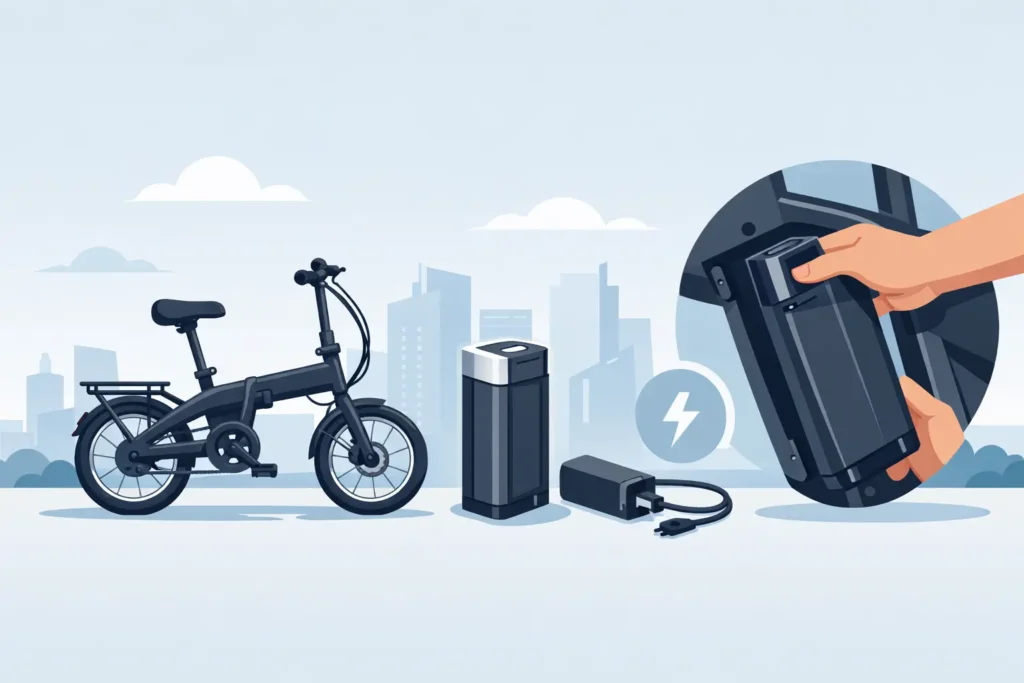
You only notice how important a battery is when your folding electric bike is waiting by the door and the power is not there. For many riders, especially those using a bike for days out, short local journeys, holidays, or gentle support with mobility, this guide to folding bike batteries is less about technical detail and more about confidence. You want to know it will charge properly, last well, and do the job when you need it.
That is really the heart of it. A folding electric bike should make life easier, not add another thing to worry about. The battery is the part that powers that freedom, so it is worth understanding the basics in plain English.
A folding bike battery stores the electrical power that helps the motor assist your pedalling. It does not replace pedalling altogether on most electric bikes, but it reduces effort, which is exactly why so many people find them such a pleasure to use. Hills feel more manageable, longer rides feel less tiring, and setting off from a standstill is often much gentler on the knees.
Most modern folding electric bikes use lithium-ion batteries. These are popular because they are lighter than older battery types, hold charge well, and are practical for regular use. That said, not all batteries are equal. Capacity, build quality, cell quality, and how well the battery works with the bike’s motor system all make a difference.
For the average rider, the key thing is not memorising voltage figures. It is knowing whether the battery gives enough range for the journeys you actually do and whether it is easy to charge, remove, and live with.
When people ask about batteries, they usually mean one of three things. How far will it go, how long will it last, and how much trouble is it going to be. Those are sensible questions.
Range depends on more than the battery itself. Rider weight, hills, tyre pressure, wind, temperature, terrain, and the level of pedal assistance all affect how far you can travel on one charge. A quoted range is usually a best-case figure, so it helps to think in realistic terms rather than optimistic ones.
If you mainly use your bike for pottering around the campsite, getting from the motorhome to the shops, or enjoying a relaxed ride along the seafront, your battery needs will be different from someone tackling steep routes every day. In other words, bigger is not always better. A larger battery may give more range, but it can also add weight and cost. On a folding bike, where portability matters, that trade-off matters more than many people expect.
Battery capacity is usually measured in watt-hours. In simple terms, the higher the number, the more energy the battery can store. More stored energy often means more range, but it is not a guarantee of a fixed distance.
A rider using low assistance on flatter ground may get excellent mileage from a moderate-sized battery. Another rider on hilly routes using high assistance will see that range drop. This is normal, not a sign that anything is wrong.
For many folding bike owners, the best battery is the one that suits regular life. If your outings are usually modest and you charge little and often, an enormous battery may be unnecessary. If you travel longer distances away from charging points, extra capacity can be well worth having.
Many folding electric bikes come with removable batteries, and for good reason. They are easier to charge indoors, simpler to store in winter, and often more convenient if the bike is kept in a garage, shed, caravan, or motorhome locker.
A fixed battery can make for a tidier design, but it may be less convenient if you cannot park near a socket. For some people this is a minor issue. For others, especially if lifting or manoeuvring the bike indoors is awkward, a removable battery is a real advantage.
A good-quality lithium-ion battery should last for years, not months. Most are rated for a certain number of charge cycles, but that does not mean the battery suddenly stops working at that point. It simply means capacity gradually reduces over time.
In practice, battery life depends heavily on use and care. A well-looked-after battery can remain useful for a long time. A neglected one may lose performance much sooner.
If your bike starts delivering noticeably less range than it used to, that may be natural ageing, but it can also be down to cold weather, under-inflated tyres, or using higher assistance more often. It is not always a battery fault.
The good news is that battery care is not complicated. The best approach is usually the simplest one.
Use the correct charger for your bike and battery. That sounds obvious, but it matters. Charging with the wrong unit can damage the battery or create safety issues.
Try not to leave the battery completely flat for long periods. Lithium-ion batteries generally prefer regular use and sensible charging rather than being run down and forgotten in the shed. Equally, if your charger reaches full charge, it is usually best not to leave the battery plugged in for days on end unless the manufacturer specifically says that is fine.
Room temperature is kinder than extremes. Charging a battery in freezing conditions or storing it in very high heat is not ideal. In the UK, winter storage is often the bigger issue. A battery left in a cold garage for months without attention can lose charge and deteriorate.
If you are not using your folding bike for a while, store the battery somewhere dry, secure, and cool rather than cold. Indoors is usually better than a damp outbuilding. Many specialists recommend keeping some charge in the battery during storage rather than leaving it empty.
It also helps to check it now and then. A small top-up charge every so often can be far better than discovering in spring that the battery has been neglected all winter.
Most battery issues start with small warning signs. Reduced range is one. Another is a battery that takes unusually long to charge or does not seem to reach full charge at all.
You may also notice the power cutting in and out, or the bike display behaving oddly. Sometimes the battery is not the true cause. Loose connections, charger faults, dirty contacts, or other electrical issues can produce similar symptoms. That is why a calm, practical check is better than assuming the worst.
Any visible swelling, unusual heat, or damage to the battery casing should be taken seriously. If that happens, stop using it and get proper advice. Batteries are reliable when cared for properly, but they are not something to patch up with guesswork.
If you ever need a replacement battery, compatibility comes first. The battery must match the bike’s system. Shape, mount, voltage, and connection type all need to be right. This is one reason specialist advice matters.
Price alone is not a good guide. A cheap replacement may look tempting, but if it is poorly made or not correctly matched, it can lead to disappointing range, poor reliability, or safety concerns. Good after-sales support can be just as valuable as the battery itself.
It is also worth thinking about how you use the bike now. If your needs have changed, perhaps with longer leisure rides or more frequent trips away, it may be sensible to discuss whether there is a suitable battery option for your present routine rather than simply replacing like for like.
If you are still at the buying stage, look beyond headline range claims. Ask where the battery sits on the bike, whether it removes easily, how heavy it is, how straightforward charging will be at home or on holiday, and what support is available if you need help later.
For riders who use folding bikes in cars, campervans, canal boats, or small storage spaces, battery design is part of the overall convenience. A bike that folds neatly but has an awkward, heavy battery may be less practical than it first appears.
This is where dealing with an experienced specialist can make a real difference. A family-run business such as AS Folding Electric Bikes understands that customers are often choosing for comfort, simplicity, and confidence, not to compare spec sheets for fun.
A battery does not need fussing over, but it does respond well to sensible habits. Keep it charged properly, store it carefully, protect it from extremes, and pay attention if something changes.
For most riders, that is enough. And once the battery side of things feels clear, the bike becomes what it should be – an easy, enjoyable way to get out more, travel more freely, and take the strain out of everyday journeys.
If you are choosing a folding electric bike or wondering whether your current battery is still right for you, the best answer is often the practical one: think about where you ride, how far you go, and what will feel easiest to live with week after week.