Looking for relaxed, scenic cycling routes without steep hills, traffic stress, or complicated planning?
Our comprehensive brochure is designed to give you all the information you need, without the jargon and without the pressure.
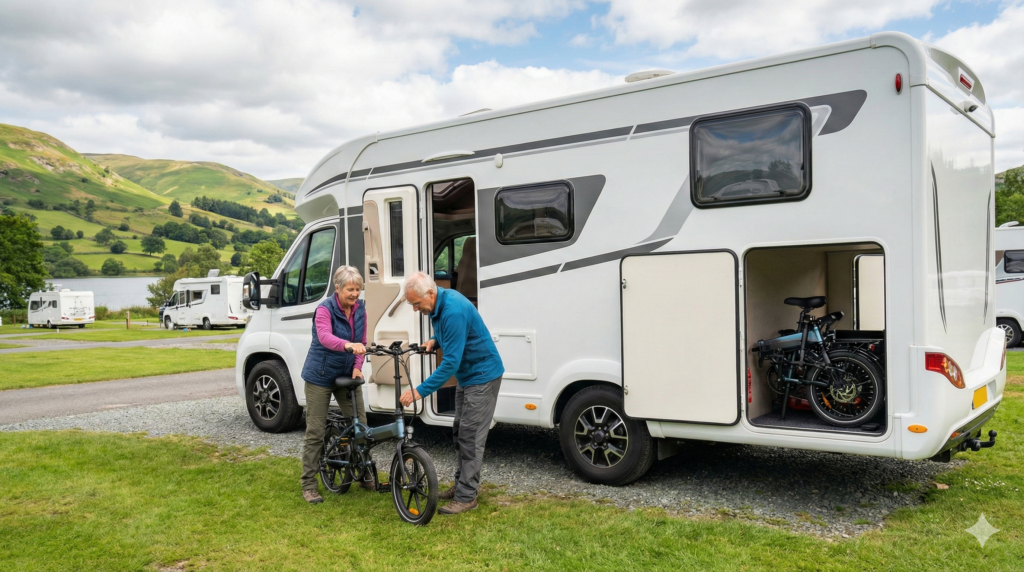
If you have visited a campsite anywhere in the UK over the last five years, you will have noticed a quiet revolution taking place. It isn’t happening inside the motorhomes or caravans; it is happening on the racks attached to the back of them. Ten years ago, you might have seen a few rusty mountain bikes hanging off the rear of a Fiat Ducato, likely ridden once and then forgotten. Today, however, those racks are carrying sophisticated, battery-powered machines that are changing the way we holiday.
At AS Bikes, we have watched this shift first-hand. In fact, we like to think we have been a part of it since our inception. But to understand why the folding electric bike has become the must-have accessory for the leisure vehicle community, we need to look at the wider industry, the technical challenges of modern motorhoming, and the changing definition of “freedom.”
Owning a motorhome is arguably the ultimate expression of travel freedom. You have your bed, your kitchen, and your creature comforts with you wherever you go. You can park up on a cliff top in Cornwall or a loch-side in Scotland and watch the sun go down with a cup of tea in hand.
However, experienced motorhomers know the “Last Mile” problem all too well. Once you have navigated the narrow country lanes, levelled your chocks, hooked up the electrics, and deployed the awning, your vehicle is effectively anchored. You are “pitched.”
If you realise you’ve forgotten a pint of milk, or if you want to visit the local village three miles away for a pub lunch, you face a dilemma. Do you pack everything away, unhook the electrics, and drive your 3.5-tonne vehicle into a village with no suitable parking? Or do you walk?
For years, boat owners have solved this with a dinghy – a small, nimble vessel to get from the big boat to the shore. For motorhome owners, the electric bike is the “land dinghy.” It bridges the gap between your campsite and the surrounding world. It turns a static holiday into an explorative one.
You might ask, “Why not just bring a standard bicycle?” This brings us to one of the most hotly debated topics in the leisure industry: Payload.
Every motorhome has a Mass in Running Order (MIRO) and a Maximum Technically Permissible Laden Mass (MTPLM). The difference between these two figures is your payload—the weight of everything you can legally carry, including water, gas bottles, food, clothes, passengers, and accessories.
As motorhomes have become more luxurious, fitted with solar panels, satellite dishes, and larger fridges, the available payload for many drivers (especially those restricted to 3.5 tonnes on a standard driving licence) has shrunk. A heavy, steel-framed mountain bike can weigh upwards of 18kg. Stick two of them on a rear rack, and you are adding nearly 40kg to your rear axle, potentially affecting your vehicle’s handling and legality.
This is where the engineering behind AS Bikes becomes crucial. Our MK3 Electrobike and Electrobike Plus are designed with weight and space in mind. By opting for a folding mechanism, you remove the reliance on heavy rear-mounted racks.
The UK is a beautiful place to explore, but it is undeniably hilly. From the rolling dales of Yorkshire to the steep coastal paths of Devon, terrain has always been the enemy of the casual cyclist.
In the past, many motorhome owners would take bikes with the best intentions, only to find that the ride back to the campsite – usually uphill – was too exhausting. The bikes would then spend the rest of the holiday gathering dust.
The modern e-bike motor, like the 250W brushless systems we use at AS Bikes, changes this dynamic entirely. It flattens the hills. The industry standard in the UK (governed by EAPC regulations) limits assistance to 15.5mph, but it’s the torque that matters. When you are pedalling up a 10% gradient with a basket full of groceries, the motor kicks in to take the strain.
This isn’t just about laziness; it’s about range. On a standard bike, a casual rider might manage 5-10 miles. On an e-bike, a 30-mile round trip to a local castle or a scenic beach becomes a leisurely morning activity, not an endurance test. It effectively triples the size of your “local area” once you are pitched up.
There is also a wider industry trend at play here. The caravan and motorhome sector is increasingly conscious of its environmental footprint. With Low Emission Zones (LEZ) popping up in cities across Europe and the UK, and campsites investing in green technologies, travellers are looking for ways to reduce their carbon output.
Using a 3.5-tonne diesel engine to drive two miles to a shop is inefficient and environmentally unfriendly. Using an electric bike, charged perhaps via the solar panels on your motorhome roof, is practically carbon neutral. It represents a form of “slow travel” that connects you more deeply with the environment you are visiting. You hear the birds, you smell the sea air, and you see the details in the hedgerows – things you miss completely from behind a windscreen.
We didn’t just jump on this bandwagon; we helped build it. Our origins in the canal boat world gave us a unique appreciation for space-saving engineering. We understand that a folding bike needs to be more than just small; it needs to be robust.
Many “toy” folding bikes on the market have tiny wheels and flimsy hinges. They are fine for a 5-minute commute in London, but they aren’t built for a gravel towpath in the Peak District. Our bikes, particularly the Electrobike Plus with 26-inch wheels, offer the ride comfort of a full-sized hybrid bike with the convenience of a folder. We use lithium batteries with no memory effect, meaning you can top them up whenever you like without worrying about degrading their lifespan – perfect for the “grab and go” nature of motorhome holidays.
In conclusion, the marriage between the motorhome and the folding electric bike is a perfect union. It solves the practical problems of storage and weight while unlocking the emotional benefits of exploration and freedom. If you are still relying on your van to do the short trips, or if your old push-bikes are rusting on the rack, it’s time to rethink your setup. The revolution is electric, and it folds away neatly under your bed.